Posts

Showing posts with the label symmetric cryptography

Perfect Secrecy and the One Time Pad (OTP)
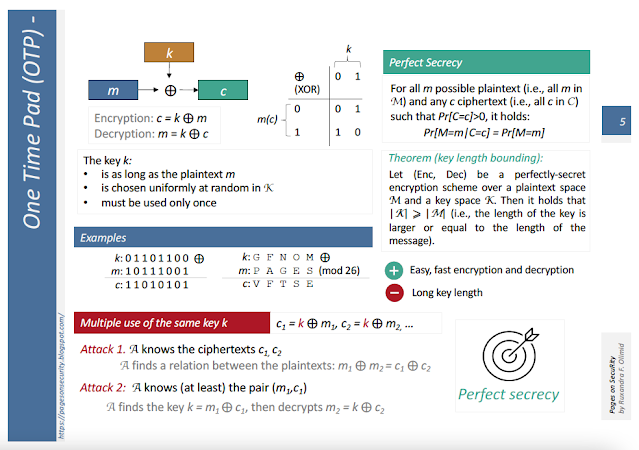
Image
I have explained unconditional  (or  information-theoretical)  security in my previous post (see Unconditional vs. Conditional Security ). As I have mentioned there, we can refer to unconditional security in the context of various cryptographic primitives, among which the  encryption schemes (see Symmetric vs. Asymmetric Encryption ). An encryption scheme that is information-theoretically secure provides  perfect secrecy (see, e.g., [1]) ,  because the  ciphertext  perfectly  hides  the  plaintext.  In other words, the adversary has the same probability to correctly indicate the message  m  regardless if he/she knows the corresponding ciphertext  c.  Hence, the knowledge of the ciphertext gives no new information about the plaintext. We ignore the length of the message - which, of course, is exposed - and assume that all the possible messages are equally long. More rigorously, the  a-posteriori ...

Symmetric vs. Asymmetric Encryption

Image
Encryption  aims to provide  confidentiality , the first listed objective in the  CIA Triad  (see  Crypt(?) ). It transforms meaningful data (the  cleartext ) into a form that conceals its meaning (the  ciphertext ). Of course, concealing should hold for all parties except the one(s) that are intended to read the data, i.e., to  decrypt. Decryption is thus the reverse operation of encryption; it means to obtain - by proper means (owning and using a  decryption  key) - the  plaintext  from the  ciphertext .  Decryption allows restoring the data in its original form by  legitimate  parties. Others (e.g.,  adversaries ) should not be able to reverse the encryption, and if they succeed (in an efficient time), this is the result of successful  cryptanalysis . If the adversary manages to revert (even partially) the ciphertext into the plaintext, we say that the ...