Posts

Showing posts with the label cryptology

Symmetric vs. Asymmetric Encryption

Image
Encryption  aims to provide  confidentiality , the first listed objective in the  CIA Triad  (see  Crypt(?) ). It transforms meaningful data (the  cleartext ) into a form that conceals its meaning (the  ciphertext ). Of course, concealing should hold for all parties except the one(s) that are intended to read the data, i.e., to  decrypt. Decryption is thus the reverse operation of encryption; it means to obtain - by proper means (owning and using a  decryption  key) - the  plaintext  from the  ciphertext .  Decryption allows restoring the data in its original form by  legitimate  parties. Others (e.g.,  adversaries ) should not be able to reverse the encryption, and if they succeed (in an efficient time), this is the result of successful  cryptanalysis . If the adversary manages to revert (even partially) the ciphertext into the plaintext, we say that the ...
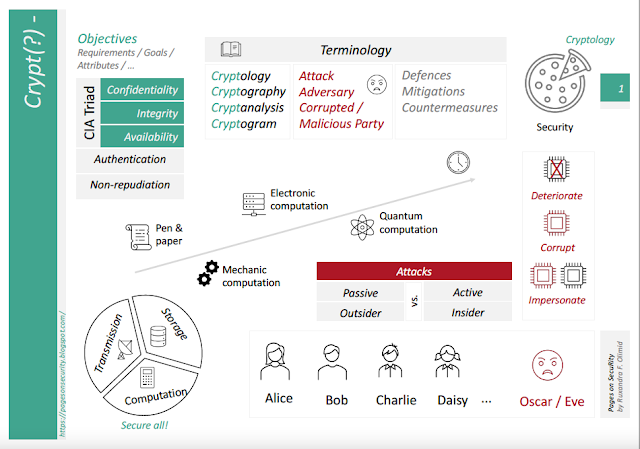
Crypt(?)

Image
Cryptology is one part of the much larger domain of (information)  security . Think of the information security field as a pizza 😃  Then cryptology is just a slice of it. Cryptology evolved continuously in time: it started with techniques that only used pen and paper, went through the era of mechanic computation, and nowadays uses electronic computing at a large scale. Today, an active research direction is  post-quantum cryptology , which considers quantum computation too. An interesting (but long!) well-known book about the history of cryptology is David Kahn's book  The Codebreakers: The Comprehensive History of Secret Communication from Ancient Times to the Internet .    Another newer, shorter book on cryptology for the large public  is  The Code Book   by Simon Singh.  As in any field, there are some (fundamental) notions you need to become familiar with from the beginning. First, there are the " crypt -" words, s...